Last week I placed an order for Richard Misrach’s book 1991. When I originally came across this body of work I was struck at just how beautiful I thought the images were, then, given my current obsession with using an 8×10 camera, was intrigued that the whole series was of one single disaster, shot on 8×10.
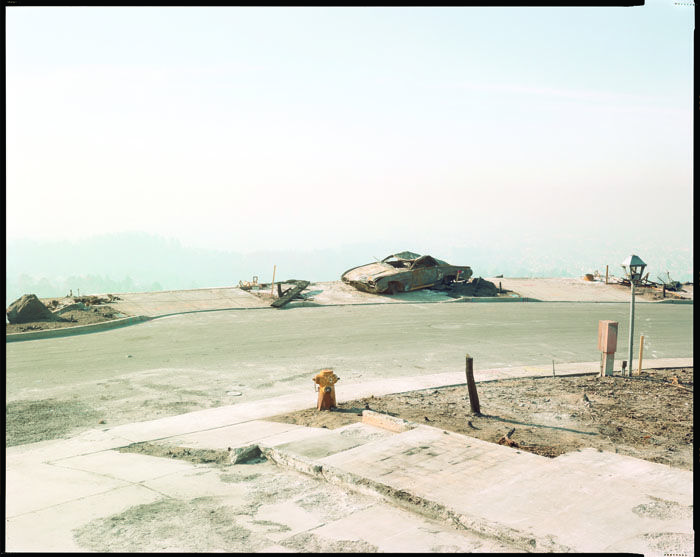
Since I’ve found this Misrach’s body of work, I’ve been debating with myself internally on if the right set of events were to happen, would I be prepared as a photographer to suddenly dump hundreds of dollars of expensive 8×10 film on shooting it over a very short period of time? Or would I just fall back to a smaller format which would allow me to take a lot more photos of the incident? I’ve also been telling myself “Hey! Maybe you should keep like 30-40 sheets on hand marked for use in some unforeseen once in a lifetime situation!”
I had last had that thought last week a few days before this year’s running of Grandma’s Marathon. I had been telling myself all year that I wasn’t going to hold back much with the 8×10 that day and try to do a bunch of portraits of exhausted runners right after they finished the race. Bloody nipples, shat pants, people right on the verge of collapsing. That sort of thing. I assessed my current 8×10 film stash a few days before and only had about twenty or so sheets left on hand. I got my gear ready and hid it in a building downtown ready to blow through most of what I had on hand.
The day of the race came, and I had absolutely no want or desire to go use up my film on it. I stayed at home all during the event and picked my gear up the next day.
It was almost as if the photography Gods had intervened and made me not shoot the race so that my stash could remain good and fat for the liquid hell looming on the horizon. A few days later on the Summer Solstice when POW, we get nailed by a once in a hundred years flooding event.
Trial by fire (or water I guess in this case) for the aforementioned question. I grabbed my 8×10 rig and plodded out into the liquid hell. Over the past two days I’ve exposed a mere fifteen sheets of film on the aftermath. In the midst of the thousands of incredible photos of the situation flooding the Internet, that may not seem like much. But damn, if those weren’t the fifteen most exhausting, surreal, depressing and yet exciting photos photos I’ve ever taken. If the results turn out as I’m expecting, I’ll have had no regrets of not grabbing a smaller camera that would have let me taken hundreds of photos. There is something about trudging through swamped out urban areas with forty pounds of gear that a photographer really sit and consider the composition and impact of every photo taken.
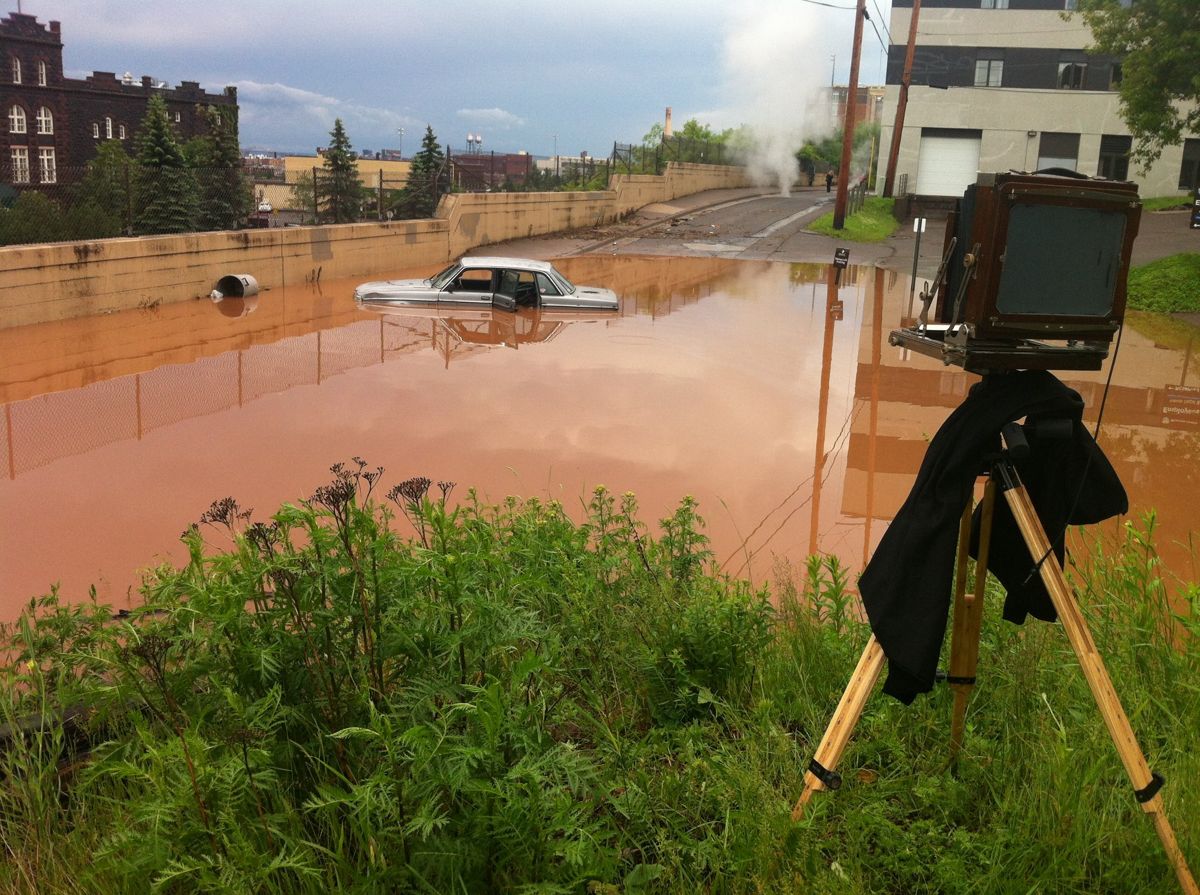
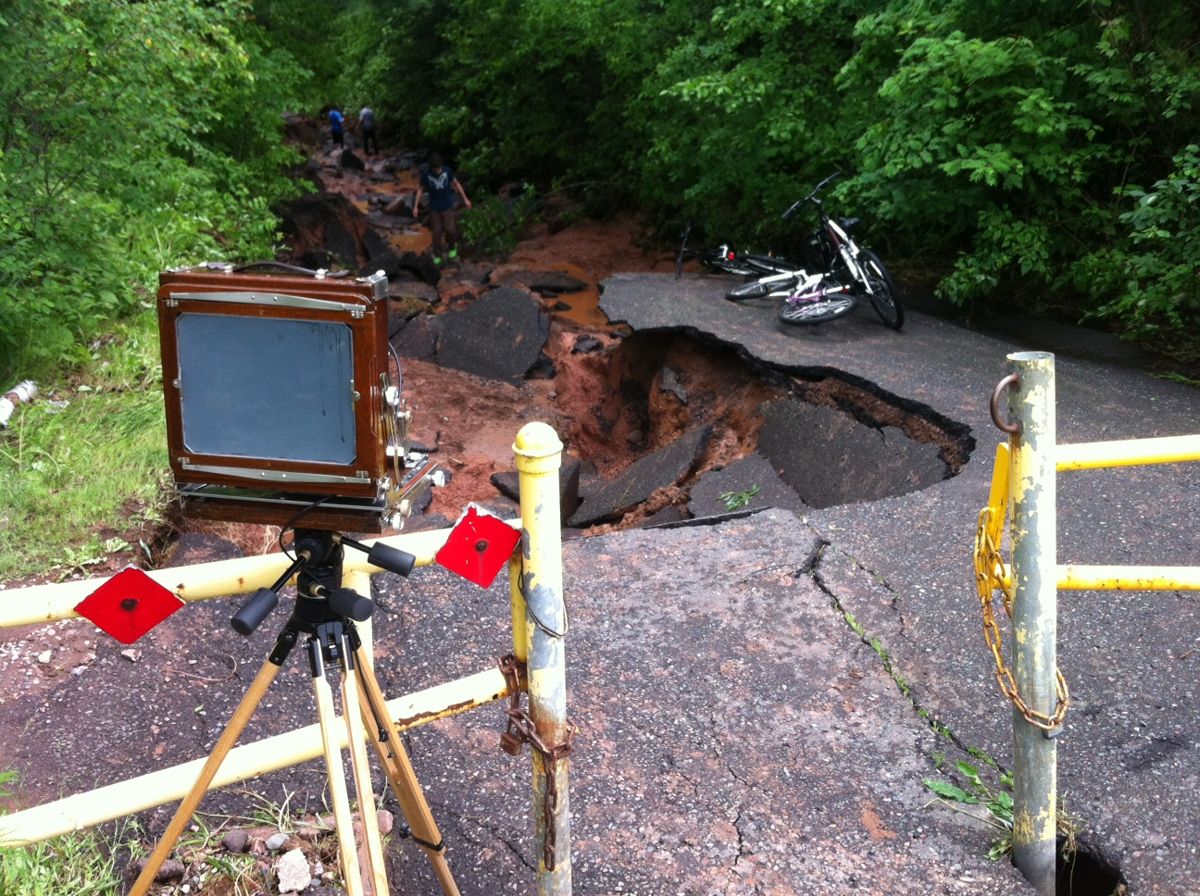
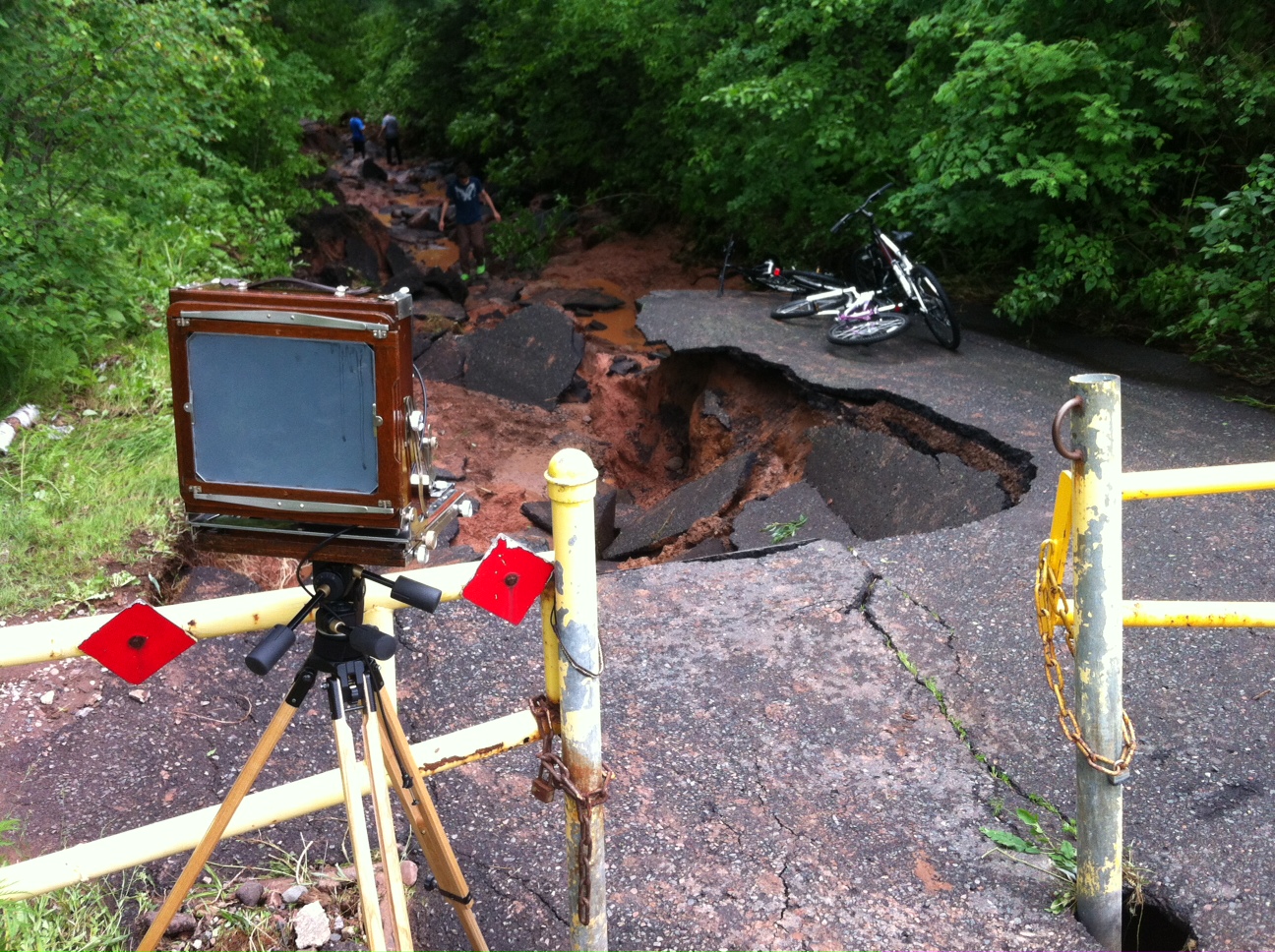
I’m not sure how long it will take me to scan and post process all of these, but I don’t expect to wait twenty years like Misrach. I just keep having terrible thoughts that some new light lee developed and they’ve all been ruined or something. Far too many people have cashed the terrible check needed to make these images.
8 Archived Comments
Kip, this is an absurdly good development. (har har har) I was reading about the flood on Perfect Duluth Day and the ‘Tribune earlier and lamenting how terrible most of the photos were and imagining what a good photographer could do with such a situation. I can’t wait to see the final images, sir.
Looking back, I’ll shoot an event with a limitation like large format and often during the event itself think: “I kind of wish I brought something easier so I could have taken a a lot more photos like the rest of the journalists there.” But afterwards the amount I get through always feels alright. However, I have quite a bit of events I’ve shot very freely with smaller formats that haven’t ever seen the light of day because I look at it all afterwards and go “Why the hell did I shoot so much!?! Ugh!!!” and never end up giving it a proper edit.
Adding the limitation I do enjoy. Thinking twice before each exposure is a good thing. Thinking four of five beforehand I like even better. I’m sure if someone was watching me work, they’d probably question why I’ll set up and futs with the camera for 4-5 minutes before picking up the whole rig, moving it over six inches and starting over. Edit first. Shoot second.
Granted, with proper discipline, the same amount of pre-editing and contemplation can be done with any format. But it seems such a waste to put that much mental energy into it and then only reward the effors with 1.5 square inches of capture quality. 😉
Interestingly, they weren’t all the same size. But as a group I’d say there were all around four feet by five feet. I suck at estimating things like this.
I’ve been mulling over some of the same issues with my Fuji Instax 210, which I’ve lately become infatuated with. The film is about 80 cents per shot. Maybe that’s not much compared to 8 x 10, but the price is enough to make me think twice before each exposure. Which is healthy. I think there is some value in having photos cost something. The fact that digital shooting is basically free results in many images that are aesthetically worthless. That’s a blunt simplification, but I think there is something to it.
Sorry Duluth got hammered. Looking forward to your pix.
I also just bought the book (was still at the museum when I went to another exhibition). It doesn’t live up to the massive size of the prints. But it’s pretty good and definitely a different way of seeing this kind of disaster.
And I’m looking forward to your results. Even the delay caused by film processing and scanning means that we edit and present things differently than we would with immediately-available digital images.
How big were the museum prints? Regardless, if they were massive I’m sure it hard to completely distill that down to a reasonably sized book, but thats is expected. So long as the reproductions aren’t as bad as some of the ones in the original American Prospects.
A healthy delay in the images is good. Let that initial shock & terror frenzy of photo sharing whip it self up until it runs out of energy and needs a nap. Then come in with the quieter, contemplative images.
We live in the “MTV microwave dinner generation” as they say, “we all want it now”, but I expect your shots even though they won’t surface for a few weeks will be a lot more meaningful and ponder-worthy than the… well… flood of Instragram-detritus currently out there.